Wild Rice harvesting at Rice Lake (Lac du Bois) video

Credit Howard Bedford Williams Family

1940s video taken with a 16mm Kodak video camera by Howard Bedford Williams shows:

  • Paddle into Rice Lake (Lac du Bois, Manitoba) up Rice Creek
  • the harvesters were families from Sagkeeng First Nations
  • Taking green rice from lake and placing in metal trough with fire underneath to parch it
  • “Dancing parches the rice to remove hulls”
  • Canoeing to rice fields
  • downtime playing baseball
  • First day of rice picking to see who could pick the most in a certain amount of time with prize for the most picked.
  • Using 1st mechanical harvester built by Bedford Williams after most hand picking was done using high volume mechanical methods to parch (bake) rice – dehull it (using grain dehulling equipment).
  • Size of chaff pile shows how much rice was processed
  • Finished bagged rice loaded onto CPR box car and sold mainly in California until Manitobans started using more rice in 1950s & 60s.
  • making a meal using wild rice

Bill Williams was the biggest sole proprietor producer of Wild Rice in Manitoba for years. 

Frank Brown by David Riach

Aviation researcher David Riach shared his extensive research with the Lac du Bonnet & District Historical Society in February 2024.

For the full version, please click: Mannifrank Brown

M. Frank Brown was a bush pilot who led airborne squadrons overseas during WWII, and owned the Red and White general store from 1945. He served on 1948 inaugural village council. His wife, Edythe, was Lac du Bonnet’s mayor from 1952-57 and Manitoba’s first female mayor.

Frank and Edythe at Osnaburgh House, Ontario, 1935

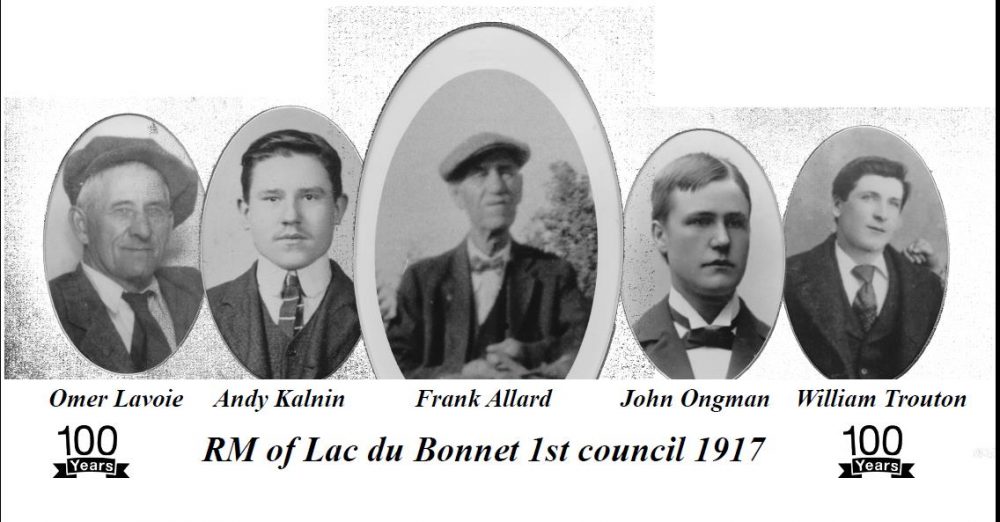
First RM Council

The first meeting of the Rural Municipality council was held in the Lac du Bonnet School House.

Some interesting items from their notes include:

  • By-Law 3 - borrow $3,000 to carry on business.
  • By-Law 4 - restraining the running-at-large of bulls over six months and colts over nine months of age.
  • Motion passed that Andy Kalnin be authorized to inspect and locate a road between the Winnipeg River and Lee River.
  • Motion to write the CPR to make arrangements for a crossing and dockage site at the foot of Third Street.
  • John Duncan McArthur pays Lac du Bonnet’s first municipal taxes for the brick plant and sawmill to the sum of $709.67.
  • Purchase the building and land on Lot # 20 Block # 2 in the Village of Lac du Bonnet for $600 to be used as the Municipal Hall. (Third Street).

The Lac du Bonnet Train Station

Written by Marcel R Pitre

The CPR Train Station in Lac du Bonnet was not unlike any other train station in Manitoba, or indeed Canada. All stations were generally the same colour, a deep unmistakable dark wine. They were the crucial, centrally located and chief facility in towns and villages as they grew in size and importance.  Stations were the hub of activity, a place where people assembled when arriving or leaving. All mail and supplies left and return that way, and in some cases, I’ve heard even individual liquor purchases were delivered by train, those were the days when roads and cars were in short supply. There were many very vital, very important functions carried on in the area that used the services of the Lac du Bonnet CPR Station.

Click here to read the full article.

The Lac du Bonnet CPR Steam Train Water Tower

Written by Marcel R Pitre 

In the early “steam-engines-train-years” huge water tanks accompanied and partnered with train tracks to quench and dispel a passing “steam-engines-driven-train” of its thirst as it makes its way across our country. And so it was that the CPR positioned their water facility...  just a part of a kilometer past Lac du Bonnet on the way to Great Falls.

Click here to read the full article.

The Intriguing Chinese Restaurant of Jim Sing

The Eagle Café – circa 1943 /44

Written by Marcel R Pitre

All Chinese Restaurants have an aura about them, most on the bright side with a few that do not challenge. Jim Sing ran a very “bright-side” business... on the “north-side” of town. The small restaurant had an entrance with a space between two doors offering protection from the north wind to those inside in winter months. Old time seating arrangements were of the type that the times dictated. Chinese cuisine, as always, was consumed with delight in a manner that cultural preference or ability would choose. Not all could navigate through the contortions of chopsticks.

Memories do not fill in the brain cavities I have of the food, nor did I have the money needed for the finery that Jim Sing’s eatery presented to a customer. It was a school teacher’s desire to obtain the words of a song for his class from the Wurlitzer that had two students expend some time there. I was one of them. What a great way to not attend classes and yet be part of the daily chores dictated by the school curriculum...  and that great teacher Mr. Solar. The song we were to obtain the words to was popular at the time though that particular number escapes me now.

It was musical education time; singing was the only instruments we had.  There was a need for lyrics to bring us up to the modern melody we desired. It was then that Mr. Solar directed Blyth Reid and myself to take pencil and paper to Jim Sing’s music box, play the desired tune wanted, all within the time that five nickels would offer, and bring the words back to class. And he supplied the change!

It was during the listening and writing time that the two of us were in a fit of laughter. Many people frequented Jim’s eatery which included the customers from the nearby Casey’s Inn. Some were not in the joyous mood that the main beverage sold there should have held them and they took exception to our laughter as a slight upon themselves. Their immediate intention was to take me outside and “clean-my-clock”. Thanks to the double doors I mentioned they could not maneuver me to the outside, we became knotted in a confined space. Jim Sing’s humour, at time, had him display his healthy meat clever to those he wished to impress... or change their minds. Though he always did so in jest I fervently hoped, while snared between two doorways, that he would have shown up then. No dice... Jim was cooking I suppose?

It was then the Dr. William (Bill) Reid, father of Blythe, appeared on the scene. It happened that there was a need to see his daughter at the school and was told where she was. Never at a better time!  Dr. Reid did not take much from anyone, particularly the two inebriates. Needless to say we did not have to put ourselves through the “contortions” of chopsticks though truly amazing twisting efforts were needed to dislodge ourselves from between the two sets of doors. The end results were that... we did get back to school with the words to a great tune, Mr. Solar was happy, Dr. Reid was glad to be in the right place at the right time, as were we. Blythe and I had a great experience on Mr. Solar’s two bits. And Jim Sing did not feel need to demonstrate the effectiveness of his meat cleaver.

Rem and Jack Shaw: Owners of the Shaw Drug Store

Written by Marcel R Pitre

Circa 1943/1945

The Shaw Drug Store: Times of long ago, apart from being interesting to read about, are somewhat the opposite of the future, memories only include the past. And those earlier periods have so many great moments that create exciting reminiscences. Rem and Jack Shaw of Lac du Bonnet, the Allard building which housed their store, the streets and structures around and the people who frequent these location, had great stories to tell.

Click here to read the full article.